This 2D-RPG engine written in Java is by far my biggest private project so far. I started this project primarily as a way to learn programming while building something fun for myself. Using the engine, I’m currently developing a Pokémon Fan game. As a foundation, I’ve used assets from older Pokémon titles like Pokémon HeartGold & SoulSilver for the Nintendo DS, combined with various open fan-made assets.
The purpose of this post is not to showcase the game itself, but rather to highlight the engine, what it does, and how it works. The engine already includes a wide range of functionality. Below are some of the highlights.
🪟 Windows
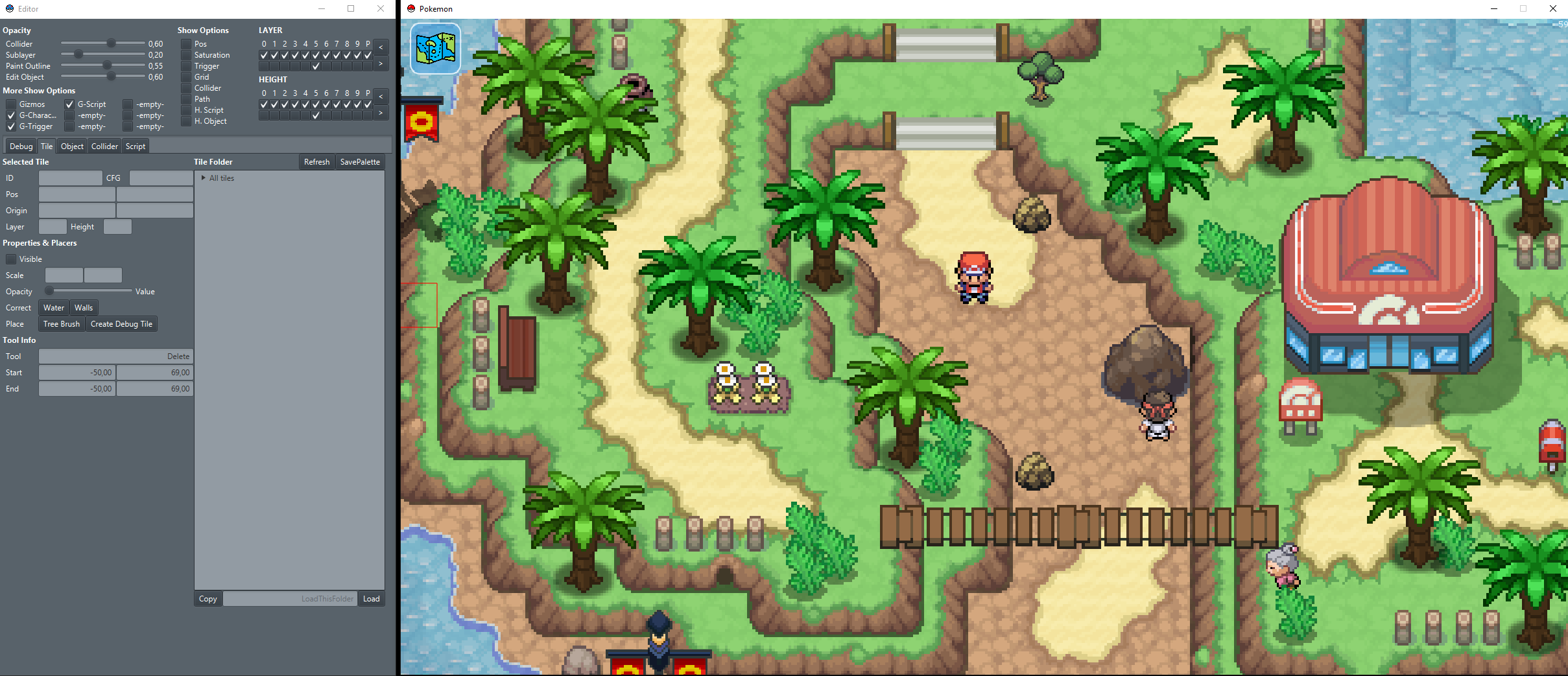
The engine runs two parallel threads, each managing one of the two main windows used during development. The Editor Window (left) runs on the UI thread, powered by JavaFX. It provides access to numerous tools and customization options for editing game content. The Game Window (right) runs on a separate game thread and uses an early version of OpenGL for rendering. This window displays the active game world, including maps, characters, user interfaces and covers utilities such as input handling and save/load mechanics.
🗺️ Mapping
The mapping system supports 10 layers for each of 10 height levels, allowing fine-grained control over world design. It provides free camera movement, zoom, and flexible layer opacity controls for better visualization. In addition, you can toggle overlays to display colliders, scripts, grids, and other visual indicators such as names, positions, and gizmos.
🎨 Painting
The painting tool enables classic tile-based map editing, inspired by the design of the original Pokémon games. You can paint directly on the tile map and also place objects off-grid for a more natural look. It supports the essential editing tools such as select, move, brush, and copy, all integrated into a dual-camera system, where one is focused on the game map and the other on the tile and object palettes area. The engine also supports auto-tiling for elements like water and walls.
🟦 Collision
The engine allows to attach or remove colliders from map objects. By using shared attributes among copied objects the engine applys collider changes to similar objects automatically. This property can but must not necessarily apply to similar attributes such as scale, opacity, trigger colliders and scripts.
📜 Scripting
Each map object can have scripts attached to define its behavior. For example, the video below demonstrates triggered animations and dialogues that occur during interactions or on-collision events.
The scripting system provides real-time access to object data and supports on-the-fly changes to dialogue and logic. Developers can easily adjust NPC paths using moveable nodes, and even change the animator (sprite animation set) dynamically during gameplay.
🖥️ In-Game UI
The engine supports custom in-game user interfaces, which are implemented directly in code. It also provides a collection of built-in components such as boxes, labels, and other UI elements, as shown below. Most of the menus displayed are still prototypes and will receive additional polish and content.